
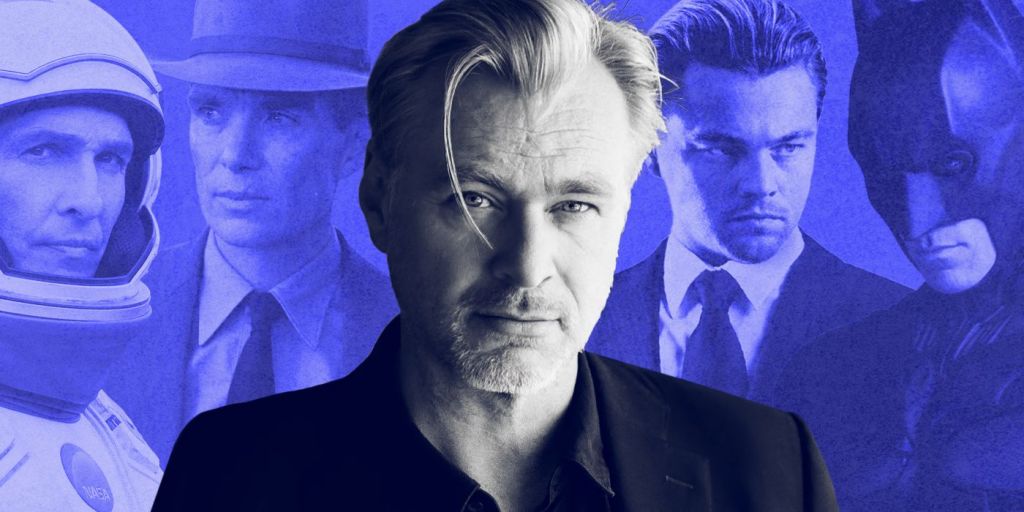
Christopher Nolan was really the first director that I started following attentively as I started to get into films. Noted for his high-concept ideas and nonlinear narratives, he first broke into the scene with Memento, earning him his first Academy Award nomination. He would then be known for his trilogy on Batman, before establishing himself as the next big director with Inception and Interstellar. Today, he is probably the only director whose name alone commands people to the theater. While he has been subject to criticisms for his perceived lack of subtlety and constant need to explain everything to audiences, he has nonetheless remained one of my favorites. Here’s my ranking of all of his films:
12. Following (1998)
Released in 1998, Following is Chris Nolan’s directorial debut. Starring Jeremy Theobald, the film tells the story of Bill, who walks the crowded streets of London following strangers as a chosen hobby, before things get a little dangerous after he crosses paths with someone from the criminal underworld. A good first outing for the British director, who shot the film himself in London on black-and-white 16 mm film stock, most of it done with only available light. Most of the cast and crew had jobs during the week, so the film was shot mostly on Saturdays for a full year. The budget for the film was $10000, and it managed to gross 12 times that amount, making for a pretty successful venture.
Really good effort. I like the fact that Nolan, who is now known for high-concept ideas and blockbusters, got his start by making a film with such a limited budget that he had to figure out a way to cut costs by only filming a few minutes a week and saving up on stock by extensively rehearsing, so that they could use the first or second takes.
11. Tenet (2020)
Released amidst the COVID-19 pandemic, the film failed to break even at the box office. The reception was also somewhat mixed, as the plot proved to be too confusing to follow for most audience members. The sound design was also criticized, as it’s hard to hear the dialogue as the music is building up, criticisms that I echo too. I watch with subtitles anyway, but without them, I wouldn’t be able to understand what the characters are saying 50% of the time. However, I still think this is a really fun movie, one that works better the less you try to understand it.
Tenet follows a spy trying to prevent World War III from happening by trying to understand the origin of objects that are travelling backwards in time. It stars John David Washington in the lead role, with Robert Pattinson, Elizabeth Debicki and Kenneth Branagh in supporting roles.
10. Insomnia (2002)
A remake of a 1997 Norwegian film starring Stellan Skarsgård, Insomnia is about a homicide detective investigating a murder in Alaska, during a 24-hour daylight period. Al Pacino stars, with Hillary Swank and Robin Williams in supporting roles. While Jonathan Demme (Silence of the Lambs, Philadelphia) was originally attached, Nolan wound up directing. The film was quite successful, and even the director of the original film from Norway praised it, for being so well-crafted. The best remakes reinterpret the themes and material, rather than just retreading familiar tropes.
Gorgeously shot with really great performances, particularly from Robin Williams as the villain, Insomnia is often forgotten when measured against the rest of Nolan’s filmography: This is perhaps because it feels generic at first, and there is an absence of the recurring themes that would perpetuate through the rest of his career. However, I always loved the film, and there is some similarity between Al Pacino’s character and Batman in his Dark Knight trilogy, particularly in the way they pursue justice (the ends justify the means). The fact that this very good film sits here is a testament to Nolan’s prowess as a filmmaker.
9. Batman Begins (2005)
The first installment in the trilogy, Batman Begins was released in 2005 to positive reviews and lukewarm box office success. 8 years after the silly and campy Batman and Robin with George Clooney as Batman, this offered a more grounded take on the Batman mythos, one that took a deeper look into Batman’s origin story, particularly when it comes to his training. In this version, he is trained by Ra’s Al Ghul, a villain from the comics, which is an interesting take. Christian Bale stars as Batman/Bruce Wayne, with Katie Holmes as Rachel Dawes, an original character created specifically for the movie, Michael Caine as Alfred the butler, Morgan Freeman as Lucius Fox and Liam Neeson as Ra’s Al Ghul.
This is a terrific movie, with impressive set pieces and character work. It’s cool to see Batman struggle through his first forays into crime fighting, dealing with injuries and failing to establish personal relationships in his daily life as the playboy billionaire. Inspired by Frank Miller’s Year One, this is a really good examination of the character’s morals, from his reasons not to kill, to his less-than-justifiable methods, as he takes on a seemingly immortal leader of an assassin league, looking to poison the water supply in Gotham with the help of Scarecrow, played by Cillian Murphy, and grapples with his fears, which harken back to his childhood trauma.
8. The Dark Knight Rises (2012)
The Dark Knight Rises released in 2012, 4 years after The Dark Knight. Expectations were through the roof, as fans anticipated the end of Nolan’s take on the Batman mythos. It received positive reviews and was a success at the box office, but it failed to live up to the impossibly high standards set by its predecessor, hailed as one of the greatest films of all time. Bane, played by Tom Hardy, was the antagonist in this one, looking to destabilize Gotham by taking control of a fusion reactor and turning it to a bomb. Batman returns after 8 years, in the aftermath of the Dent Act. Anne Hathaway also stars as Catwoman, marking the character’s debut in the trilogy.
The Dark Knight Rises is a direct response to The Dark Knight’s cynicism and ambiguity, and the public response around it. Batman taking the fall in the previous movie offered a period of peace, built on a lie. The film questions whether stability built on deception is sustainable in the long term. While institutions fail in The Dark Knight, they recover in Rises, where collective resilience and hope are big themes. People questioned how Bruce Wayne was able to return to Gotham when every conceivable way into the city was destroyed, how he didn’t die in the bomb explosion (despite it being explained that he had fixed the autopilot months before, and could have jumped a good few minutes before it goes into the distance), or how the police were able to survive for 5 months being trapped underground. While I understand these criticisms, and echo others, the film’s strength and effectiveness on me lies on its allegories, and message of hope and recovery. Not to mention the kick-ass action scenes.
7. The Prestige (2006)
The Prestige released in 2006, starring Christian Bale and Hugh Jackman as two aspiring and feuding magicians in early 20th century. Scarlett Johansson, Rebecca Hall and Michael Caine round out the cast. It feels wrong to have The Prestige so low here, but just know that the next four slots are interchangeable. It kind of depends on which one I watched last. It’s been a while since I rewatched this film, and that might have something to do with its placement here, but I think of it on equal terms as the following 3 movies.
It enjoyed a bit of success when it first came out, and it has endured over the years, with many still claiming it as one of the stronger films in Nolan’s filmography. While one of the magicians is more brilliant from a technical standpoint, he lacks in showmanship and presentation, which the other excels in. Duality and secrecy are the main themes of the film, as the two engage in a deadly duel, sacrificing more and more of their humanity at each turn trying to one-up the other.
6. Inception (2010)
This mind-bending science-fiction thriller about dreams within dreams was released in 2010, following the success of The Dark Knight. Leonardo DiCaprio stars as Dominic Cobb, a wanted criminal who steals secrets from subject’s subconscious by entering their dreams. After a failed job on Saito (Ken Watanabe), he is hired by him to implant an idea in the subconscious of the heir to an energy conglomerate’s empire, in exchange for immunity. He then assembles a team capable of pulling off such a job.
Acclaimed for its inventive action set pieces and awesome visuals, Inception is at its core a story about guilt, grief and letting go. Cobb is haunted by memories of his wife, who plagues his own subconscious and becomes an obstacle when doing jobs. While 90% of the dialogue in this film is expository, as the characters break down the rules of the dream world and explain every little thing to the audience, offering little room for it to speak for itself, the film is still an incredible achievement. Audiences still question the meaning of the ending, and whether it is a dream or reality. I say: Does it matter?
5. Memento (2001)
Memento debuted at the Venice International Film Festival in 2000, before releasing widely in the US in 2001. It was touted as an incredible feat in storytelling, which earned Nolan his first Academy Award nomination for Best Original Screenplay. It follows a man experiencing anterograde amnesia (played by Guy Pearce) hunting for the man who killed his wife, using body tattoos to remember his objective as he suffers from short-term memory loss and the inability to form new memories. The film actually has two narratives, one ordered in reverse, shown in color, and the other advancing forwards in time told in black-and-white. They both converge to the same point in time, after which we can finally piece the whole story together.
This was a brilliant way to let the audience sympathize with the main character’s situation, since we can’t recall the past events being referenced in the colored scenes as we have not seen them yet. It is also quite a bold move, since we know where the story is going from the start, we just don’t know the starting point to that decision (which is actually the midpoint of the story where the two timelines meet). Great film that analyzes how we can be deceived by our memories, which are not always reflective of what happened in reality, and how we shape those memories by forgetting things on purpose, or by our perception of reality. Nolan noted how audiences question the reliability of one particular character from the minute they’re introduced, but mostly fail to question the one character whose memory is actually damaged. This happened to me the first time I watched the film, leading me to feel the ending fell flat. However, upon rewatching it multiple times, it is quite an ingenious way to finish.
4. Interstellar (2014)
In a world ravaged by blight and dust storms, a former astronaut turned farmer is recruited by the remains of NASA to lead a team of scientists into a wormhole near Saturn, in the hopes of finding another world to inhabit. Theoretical physicist Kip Thorne was an advisor on the film, which provided insight into black holes and helped his team publish 3 scientific papers in peer-reviewed journals. Noted for its scientific accuracy, Interstellar got somewhat mixed reviews while being a success at the box office. In the years since, it has become more well regarded, as its message of the endurance of love, and hope for humanity has become more widely accepted.
The film raises a lot of interesting questions, related to fate and determinism, the relationship between faith and science (sharing a lot in common with Carl Sagan’s Contact, which was adapted into a film directed by Robert Zemeckis in 1997), and the relationship between family and duty. It should come as no surprise that Steven Spielberg was actually set to direct this at first, before Nolan took over the project, since it shares a lot of themes with most of his films, from parental abandonment, to fulfilling one’s duty and responsibility in the face of incredible danger. An absolutely visceral experience, especially in IMAX, Hans Zimmer’s score and Hoyte van Hoytema’s cinematography make this an unforgettable experience. The cynic in me does groan at the twist in the third act, but I am so compelled by the rest, I can’t help but give in.
3. The Dark Knight (2008)
Released 17 years ago as a sequel to 2005’s Batman Begins, The Dark Knight sees Batman continue his crusade against crime in Gotham, teaming up with Lt. James Gordon and District Attorney Harvey Dent to bring down the mob’s influence in the city, while also dealing with a new threat in the form of the Joker. Massive hit in the box office and with critics and audiences alike, garnering 8 nominations at the Academy Awards, with Heath Ledger winning posthumously for Best Supporting Actor.
A deconstruction of the superhero genre and a reflection of the politics of its time (as I discussed in a previous post), The Dark Knight is an incredible crime action film, with the entire sequence of the chase through the lower streets ending in the truck-flip in downtown Gotham (which is actually Chicago) being one of the very best in the action genre in the past 30 years. I wish Nolan had let some of the moments breathe a little more, as the film moves at a brisk pace, sometimes to a fault. Some moments of quietude and stillness with Bruce Wayne/Batman, as a man continually at the edge of breaking and employing more and more extreme methods in the relentless pursuit of justice at all costs, would have been appreciated, and would have helped to understand the inner conflict of the character, whose ethics are constantly challenged as infringing moral standards. However, I still think this is a near-perfect film, that excels in reflecting a sense of moral panic and ambiguity felt particularly in post-9/11 America.
2. Dunkirk (2017)
Dunkirk (2017) covers the retreat of the British forces from the beaches of Dunkirk in 1940 during World War II, with the film following three different fronts of battle – land, sea and air – each set during a different timeframe; 1 week (land), 1 day (sea) and 1 hour (air). The film was met with anticipation for being the first war film Chris Nolan directed, while employing another notable and large cast. Some questioned the PG-13 rating and Harry Styles’ (of One Direction fame) casting. The film was very well received, and it wound up becoming the most successful war movie to date.
Before rewatching this recently, I never would have put this film so high on my list. When I first watched it when it was released, I thought it was good but not great, and more of an exercise in juggling different narratives, than an actual film with character arcs. However, upon a second viewing, I loved it and now see it as a masterpiece. While some may struggle with the lack of character development and backstory, which I completely understand, I viewed it as an attempt to create empathy with the characters by simply portraying them as human beings, as soldiers trying to survive, rather than creating empathy by having them perform heroic sacrifices or divulging information about themselves. I couldn’t help but feel emotional when Kenneth Branagh’s character looks toward the horizon and sees all the citizen ships coming to the rescue, or when the soldiers finally get home and are received warmly by the public instead of being shunned as they expected. Incredible cinematography and sound elevate a lot of scenes, particularly the aerial dogfight sequences. I also recommend listening to Quentin Tarantino’s experience watching the film in London, which he talked about in the Ringer’s Rewatchables podcast. He saw in everybody a great sense of pride watching the film. Truly remarkable stuff.
1. Oppenheimer (2023)
Oppenheimer came out two years ago, in the same weekend as Greta Gerwing’s Barbie, making way to the Barbenheimer phenomenon. Both films were huge successes at the box office, with Chris Nolan’s making nearly $1 billion dollars worldwide, quite the feat for a biopic about a 20th century theoretical physicist. Adapted from American Prometheus: The Triumph and Tragedy of J. Robert Oppenheimer (2005), and covering events from Oppenheimer’s life, from his life at Cambridge when he was still studying physics, to his time as the project director of the Los Alamos laboratory section of the Manhattan Project, in which he oversaw the construction of the first nuclear bomb, to his security clearance hearing a number of years later. Filmed in IMAX and large-format 65 mm film stock, the film features both color and black-and-white photography, with the color scenes comprising the Fission chapter, and the black-and-white scenes belonging to the Fusion chapter.
The film’s story is told in nonlinear fashion, going back and forth between the security clearance hearing and the events that preceded it, focusing primarily on the construction of the atomic bomb. Oppenheimer’s personal life and struggles are framed in the context of the hearing, as his integrity and loyalty to the government of the United States was being questioned. This is Nolan’s deftest to date, doing away with the over-explanation that plagued his previous efforts, with the director giving the bigger moments time to breathe. Cillian Murphy’s performance here is fantastic, especially in the quieter scenes, as it relies primarily on his facial expressions. The standout scene comes in the aftermath of the bombing of Hiroshima and Nagasaki, as Oppenheimer addresses the residents at Los Alamos, with patriotic claims, while struggling with the guilt of his actions. The sound design and lighting elevate this moment, making for a fascinating depiction of character psychology. Truly, Nolan’s best to date.



 Kino Meditations
Leave a comment