
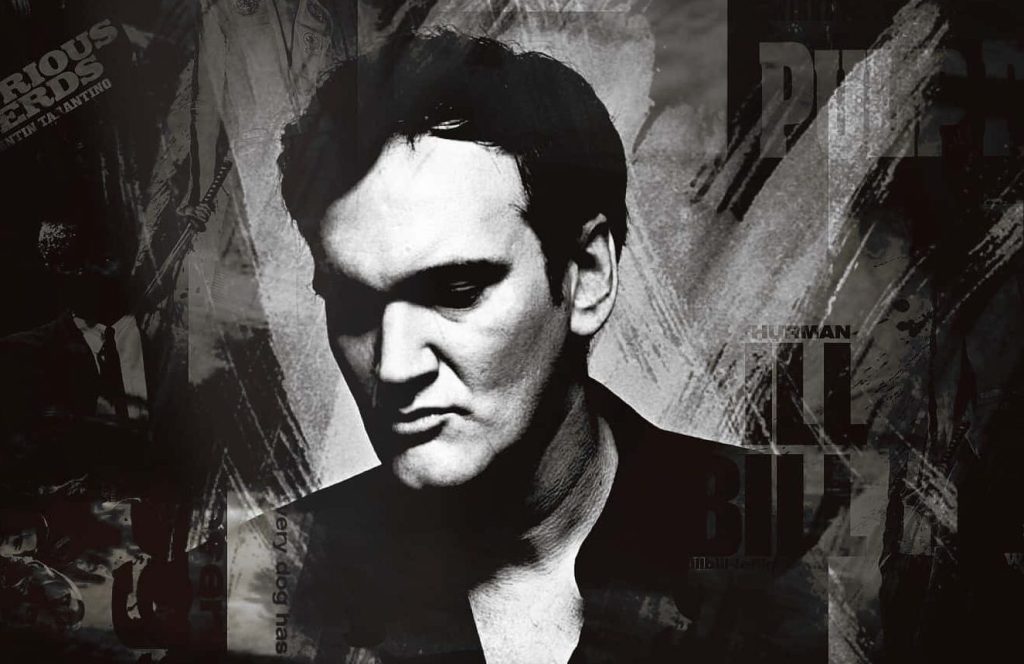
One of the defining directors of the modern era, Quentin Tarantino has written and directed some of the most enduring works of the past 30 years. Born in Knoxville, Tennessee, and raised for the most part in the Los Angeles area through the 70s and 80s, Tarantino has directed 10 (or 9, if you ask him) feature films, and written many others. Today, I will attempt to rank his directorial efforts, as we await his next (and presumably final) film.
9. Reservoir Dogs (1992)
Premiering at Sundance Film Festival in 1992, Reservoir Dogs was Quentin Tarantino’s debut film as director. A production budget of $1.5 million was raised with the assistance of Harvey Keitel, and the film ended up grossing nearly $3 million dollars. An independent filmmaking sensation, the film starred Harvey Keitel, Tim Roth, Chris Penn, Steve Buscemi, Lawrence Tierney and Michael Madsen as a group of thieves hired to complete a jewelry store heist that goes terribly wrong.
It might seem blasphemous to put this film at the bottom of my list, but I still think this is a great film, and a terrific exercise in nonlinear storytelling. The only reason it’s here is because I prefer the rest of his filmography. Influenced by Stanley Kubrick’s The Killing (1956), and Martin Scorsese’s Mean Streets (1973) and Goodfellas (1990), the film is Tarantino’s take on the heist film. By not showing said heist, the film focuses more on the characters and their backstories, clueing us in on what transpired as they discuss the events at the warehouse. Michael Madsen stands out for his terrific performance of Mr. Blonde. May he rest in peace.
8. The Hateful Eight (2015)
I find it appropriate that this film sits here. I find it similar to Reservoir Dogs, as characters find themselves locked in the same location, with revelations being made as time goes on. In Reservoir Dogs, these revelations come to inform the audience of what happened wrong at the heist and who might be the informant, while in The Hateful Eight, they mostly tell us how these characters are all seemingly related to each other through their backstories despite evidence to the contrary initially. Samuel L. Jackson, Walton Goggins, Kurt Russell, Jennifer Jason Leigh, and others star, as strangers stranded and seeking shelter in a haberdashery in the midst of a blizzard.
Originally conceived as a novel, Tarantino developed a script which was leaked in early 2014, leading him to abandon the project. After a live reading of said script, he was convinced to resume and direct the feature, which released in December of 2015. With an incredible score by Ennio Morricone (might be my favorite score in a Tarantino film), the film enjoyed success at the box office and Jennifer Jason Leigh was nominated for an Oscar for Best Actress in a Supporting Role. Samuel L. Jackson also delivers an incredible performance, which featured an exceptional scene in which he taunts Bruce Dern’s character with a story of his son (let’s just leave it at that). Incredibly thrilling film built mostly on character.
7. Kill Bill Vol. 1 (2003) & Kill Bill Vol. 2 (2004)
I chose to combine the two features, which were released separately in theaters, since Tarantino himself considers them one movie, as it was so, before being split in two to accommodate for the lengthy runtime. Starring Uma Thurman as The Bride, the films are about a former assassin – who was nearly murdered in the day of her wedding – looking to get revenge on the people who wronged her. While the first feature focuses more on action, as the Bride travels to Japan where she battles the yakuza, the second explores the lead’s backstory in the Deadly Vipers, as well as her relationship to Bill.
Inspired by martial arts and samurai films as well as spaghetti westerns, the first film features an anime sequence directed by Kazuto Nakazawa. A wildly entertaining spectacle with incredible choreography and stunt work, it took me quite some time to warm to the film’s stylized violence. While Vol.1 is action-heavy, lacking in more dramatic fare, Vol. 2 delivers primarily on that front, and I found myself quite intrigued by Bill’s character, wonderfully brought to life by David Carradine, who has endured as one the best villains in modern cinema history.
6. Death Proof (2007)
Released theatrically as part of the double feature Grindhouse, which combines this film with Robert Rodriguez’ Planet Terror, Death Proof tells the story of a stuntman who preys on young women with his modified car. A slasher film, Tarantino sought to take the structure of typical slasher films and use it against the audience. Featuring Kurt Russell as the murderous stuntman, the film is also notable for casting Zoe Bell, who previously served as Uma Thurman’s stunt double in Kill Bill, in a starring role.
Typically found at the bottom of these types of lists, I find this film wildly entertaining. Using many unconventional editing and cinematography techniques (the film is also Tarantino’s first credit as cinematographer), it is made to look like the blaxploitation films that played in grindhouse theaters in the 1970s, which the director grew up watching. While the first half, which features jump-cuts and looks damaged, focuses on the stalking and murder of a group of friends who meet at a bar for some drinks, the second half sees Kurt Russell’s character attempt the same on another group of friends, two of which are stuntwomen, featuring an incredible car chase scene with several collisions, all while Zoe Bell (playing a version of herself) is strapped to the hood of one of the cars. Riveting stuff.
5. Jackie Brown (1997)
Jackie Brown, released in 1997, remains the only film directed by Tarantino to be adapted from existing source material, in this case Elmore Leonard’s Rum Punch novel. The director has said before that Leonard’s novels and writing were an influence, an influence which is in fact noted in Reservoir Dogs and Pulp Fiction. It received positive reviews and was successful at the box office, but it failed to match the spark of Pulp Fiction. It was also very controversial due to its language, particularly the use of the n-word. As such, many would place it in the lower tier of Tarantino’s films.
However, I think this is a stone-cold-classic. Pam Grier’s performance as the titular character is incredible and one of my favorite performances in any Tarantino film, which is saying something. Samuel L. Jackson and Robert Forster are equally good, with the latter earning an Academy Award nomination for Best Supporting Actor. While the film features Tarantino’s trademark humor and violence, it otherwise follows the novel closely, and it makes for a great double feature with Steven Soderbergh’s Out of Sight, also adapting Leonard’s work, with Michael Keaton even reprising his role as Ray Nicolette. A very effective, smart and slick crime thriller.
4. Django Unchained (2012)
These next two entries are hard to rank for me, and it depends on which one I watched last. As such, they are interchangeable. Released in 2012, Django Unchained marked Quentin Tarantino’s bold dive into the spaghetti western through the lens of American slavery. Set in the antebellum South, the film follows a freed slave, Django (Jamie Foxx), who partners with a German bounty hunter (Christoph Waltz) to rescue his wife from a brutal Mississippi plantation owner (Leonardo DiCaprio). Like many of Tarantino’s films, it was both a critical and commercial success, earning over $400 million worldwide and receiving five nominations at the 85th Academy Awards, including a win for Best Original Screenplay and Best Supporting Actor for Waltz (who was really a co-lead).
The film was met with controversy for its frequent use of racial slurs and stylized violence, with some critics questioning the appropriateness of blending such a serious historical subject with pulp cinema tropes. Most of my problems with the film lie in the third act and its lengthy runtime, overstaying its welcome a bit. The stylized gunfights, Morricone-inspired score, and rich visual homage to western classics, however, offer plenty to love in a film that confronts the horrors of slavery with satire and violence.
3. Inglourious Basterds (2009)
Inglourious Basterds debuted at Cannes in 2009, and opened in theaters a few months later, to critical acclaim and box office success, becoming Tarantino’s highest grossing film until Django Unchained 3 years later. It tells an alternate history story, where two plots to kill the highest-ranking commanding officers of the Nazi Party at a Paris cinema converge. Brad Pitt stars as Lt. Aldo Raine, the leader of a black ops commando team composed mostly of Jewish Americans – the eponymous Basterds – with Christoph Waltz as SS col. Hans Landa, in a role that earned him his first Academy Award for Best Actor in a Supporting Role, Michael Fassbender as Lt. Archie Hicox, a film critic turned British commando who goes to meet a German film actress, played by Diane Kruger, to carry out the assassination plot, and Melanie Laurent as Shosanna Dreyfus, the owner of the cinema, seeking vengeance for the murder of her family.
With sharp dialogue, tense set pieces, and inventive structure, each chapter unfolds like its own short film. Although I don’t really like the sparse use of narration (which features in only two instances of the film) and would prefer to do away with it completely (something that I echo in other works from Tarantino actually, as it takes me out of the experience), I simply can’t look away from this, with its magnetic performances and outstanding direction. While the infamous opening scene, dripping with suspense and punctuated by violence, has become one of Tarantino’s most iconic, my favorite section of the film is Chapter Four, aptly named OPERATION KINO, where another incredible scene takes place – the tavern sequence. Inglourious Basterds isn’t your typical war film, in fact functioning more like a western than anything else. It’s also a film about the power of storytelling and of film itself, and the role of spectacle in rewriting trauma.
2. Once Upon a Time in Hollywood (2019)
The latest film by Quentin Tarantino came out 6 years ago this month, and it follows a fading actor and a stuntman in Los Angeles in the late 60s trying to adapt to New Hollywood. Parallel to this, the threat of the Tate murders looms. The film was very successful at the box office, and it went on to earn 10 nominations at the 92nd Academy Awards. Leonardo DiCaprio stars as Rick Dalton, once a star of a western TV show, now struggling to come to terms with the changing landscape of the film industry, Brad Pitt stars as his best friend and stunt double, and Margot Robbie stars as Sharon Tate.
The film received criticism for the limited dialogue given to the character of Sharon Tate, the overall treatment of female characters as well as the depiction of Bruce Lee. Sharon Tate has a sort of ethereal nature to her character by being depicted this way, however, and Robbie herself has said that it was enough to capture her grace and legacy. By subverting history and exacting a kind of cosmic justice, Tarantino is also righting a wrong in a way. It should also be noted that the Bruce Lee scene is viewed through Cliff Booth’s perspective, and therefore, is purposely stereotypical. Booth is in fact the central character to the plot of the film, his story being the connective tissue between all the different parallel stories. The movie is a homage to a bygone era of Hollywood, and a fantastic hang-out film. Featuring several shots that echo Sergio Leone’s work, this has become one of my favorite films to rewatch.
1. Pulp Fiction (1994)
Still his masterpiece. An early favorite of mine, Pulp Fiction tells an intertwining tale of two gangsters, a mob boss’ wife and a boxer in Los Angeles. With a poster that adorned every dorm room in America for most of the 90s, Pulp Fiction has come to define Tarantino as a writer and director, with a dialogue that references pop culture and films through casual conversation. The story is told out of chronological order, and is evocative of stories in crime fiction magazines (or “pulp” magazines) that were popular in the mid-20th century. Debuting at Cannes, where it earned the Palme D’Or, the film has endured as a seminal work, influencing several other directors and artists, with its trademark combination of humor and violence.
Following three different narratives that span across two days, the film features John Travolta as Vincent Vega, a gangster that has to take his boss’ wife (Mia Wallace, played by Uma Thurman) out on a date, Samuel L. Jackson as his partner Jules Winnfield, who is looking to get out of this life, and Bruce Willis as Butch, a boxer that is paid by Marsellus Wallace, the mob boss, played by Ving Rhames, to lose a fight on purpose. With several incredible scenes (especially one with Christopher Walken in a flashback), Pulp Fiction is one of the most rewatchable films of all time, and not only Tarantino’s best, but certainly one of the best in cinema history.


 Kino Meditations
Leave a comment